How the data center boom is reshaping US housing markets | Inman
The competition goes beyond zoning fights — and housing is losing on multiple fronts
by Nick Pipitone May 15, 2026
By now, everyone knows data center development in the U.S. has reached stunning proportions. Communities from Northern Virginia to suburban Texas are organizing against new projects, zoning fights are multiplying and data center hyperscalers are outbidding homebuilders for vacant land at prices that would have seemed absurd just a few years ago.
Nearly half of Americans now oppose having an AI data center built in their neighborhood, edging out apartments as the development type people least want next door, according to a Redfin-commissioned survey.
But one data point puts the scale of the shift in starker terms than any of those local fights or surveys can.
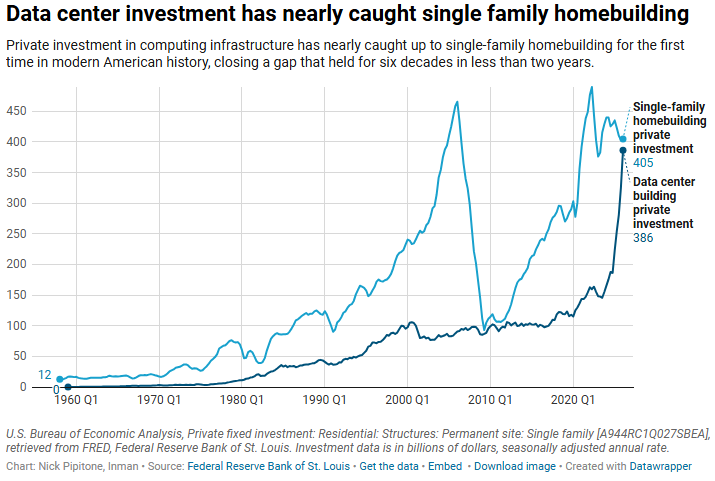
Federal Reserve data on private fixed investment show that spending on computers and peripheral equipment has exploded from roughly $150 billion to nearly $400 billion in less than two years, thanks in no small part to the boom in artificial intelligence development.
Single-family residential investment, meanwhile, has stayed essentially flat at around $400 billion over the same period. Two lines that spent six decades running parallel, with homebuilding well ahead, are now nearly touching.
To appreciate how remarkable that is, consider the longer history.
From the 1960s through the 2000s, single-family homebuilding dominated private investment while computing infrastructure barely registered. The housing bubble of the mid-2000s sent homebuilding investment to nearly $500 billion before the financial crisis wiped it out. Through it all, the structural gap between the two categories remained wide, though it was briefly close following the housing crash of 2008-2009.
That gap is now gone. For the first time in modern American economic history, building computing infrastructure is drawing private capital at roughly the same scale as building homes. That is the context behind every zoning fight, every rezoned parcel and every electrician who left a homebuilder for a data center job.
‘I don’t think a residential developer can compete’
Nationwide, data center developers and homebuilders are increasingly fighting over the same parcels of vacant land, and in many cases, the homebuilders are losing.
The competition is most visible in Northern Virginia, long the epicenter of the data center industry, where land prices have reached levels that make residential development much more challenging.
In November 2025, SDC Capital paid $615 million for 97 acres in Leesburg, roughly $6.3 million per acre, for land that JK Land Holdings had assembled for about $57 million largely in 2021. CBRE’s North America Data Center Trends H2 2025 report puts Northern Virginia and Northeast data center site costs above $8 million per acre.
“I don’t think a residential developer can compete,” said Arif Gasilov, a partner at sustainability and ESG consultancy Gasilov Group who has studied the relationship between data center infrastructure and housing markets.
The pressure on existing neighborhoods is visible, too. A developer approached homeowners in Ashburn, Virginia’s Regency subdivision with a proposal valuing the land at roughly $4.4 million per acre, according to reporting by Data Center Dynamics, which would put the total buyout of the 143-home neighborhood at around $576 million. The city in Loudoun County is in the heart of Virginia’s “Data Center Alley.”
The current HOA president has said no formal offer is in place, and the original proposal — which required unanimous agreement from all 143 homeowners — reportedly stalled.
But the episode illustrates how thoroughly the economics of land in the region have been rewritten by hyperscalers like Amazon, Microsoft and Google, which need large parcels with access to power and fiber and can outspend residential developers to get them.
“When servers move in, the market shifts,” said Rafay Baloch, CEO and founder of cybersecurity firm REDSECLABS, who has watched the dynamic play out across multiple markets. “There is real pressure. We need to do a better job of zoning, of brownfield redevelopment, and making sure that data centers are safe and secure from the get-go.”
If you can’t beat ’em, join ’em
Perhaps the most telling sign of how the economics have shifted comes from Natelli Communities, a residential and commercial developer based in the Mid-Atlantic. Natelli Communities is a private, family-owned developer with 40-plus years of building master-planned communities. They’ve been quietly pivoting toward data centers using the same master-planning playbook.
In 2021, CEO Tom Natelli invested in and joined the board of Quantum Loophole, which helped develop a gigawatt-scale data center park in Frederick County, Maryland. Late last year, the family’s Natelli Holdings arm proposed a campus called New Hill Digital Campus near Apex, North Carolina — four buildings designed for up to 300 megawatts of capacity — before withdrawing the application in March amid fierce local opposition.
Simultaneously, Natelli Holdings proposed a data center campus in Calvert County, Maryland, sweetening the deal with a $30 million regional park to soften opposition, only to run into a wall of community resistance and a threatened moratorium.
“A residential developer choosing data centers over housing because the economics are better is very interesting,” said Gasilov.
Other homebuilders have also leaned in, rather than fight, the data center boom.
PulteGroup, America’s third-largest homebuilder, recently announced an early-stage partnership with Nvidia and startup Span to install small “fractional data centers” — called XFRA units, powered by Nvidia’s liquid-cooled RTX PRO 6000 Blackwell Server Edition GPUs — on the exterior of newly built homes.
The pitch is that new construction has underutilized electrical capacity that can run distributed AI compute. Homeowners get discounted electricity and internet rates rather than direct energy cost offsets.
Span claims 8,000 units can be deployed six times faster and at one-fifth the cost of a comparable centralized 100-megawatt data center. Deployment is in its earliest stages, with PulteGroup confirming units have been installed in at least one home in each of a handful of communities so far.
Natelli is the clearest example of a residential developer trying to transfer master-planned community expertise directly into data center development. The challenge is that data centers face a fundamentally different reception from the community than housing does.
PulteGroup’s XFRA experiment is the opposite approach — distributing compute into homes rather than concentrating it — and it may prove to be a smarter political path, even if the scale is tiny today.
The ripple effects
The effects on housing extend well beyond the parcels that get rezoned for data center development. Gasilov identifies three distinct channels through which data center growth makes nearby homes more expensive, even when housing does get built.
Utility costs are the most direct. In Virginia, the State Corporation Commission approved Dominion Energy base rate increases of $11.24 per month for the average residential customer in January 2026, part of a broader grid buildout that data center demand is widely seen as driving.
Virginia legislation that would shift more of those infrastructure costs onto data centers — SB 253, sponsored by Sen. Louise Lucas — passed the legislature, survived a round of gubernatorial amendments in April, and was signed into law in modified form. The SCC had estimated the original cost-shift provision would reduce residential bills by about $5.52 per month.
“That tells you how much residential customers are currently subsidizing,” Gasilov told Inman.
Construction labor is another pressure point.
The Texas Tribune reported in April on data centers in Abilene, Texas, pulling electricians away from homebuilders, with electrical subcontractors accounting for between 45 percent and 70 percent of data center construction budgets, according to the International Brotherhood of Electrical Workers, a labor union that represents electricians.
Abilene builder Gene Lantrip said that homes were taking two months longer to complete than before the data centers arrived. “My subcontractors don’t have the people. My electrician lost two of his lead men and several of his helpers to the data center,” Lantrip told the Tribune.
Just outside Abilene, a 4-million-square-foot AI data center called Stargate — backed by OpenAI, Crusoe and Oracle — is reshaping the local economy before it even opens. The project is outbidding homebuilders for skilled labor, as Lantrip said, with electricians on the Stargate site earning twice as much as residential subcontractors.
Then there’s what Gasilov calls the second-order effect on housing supply. “When parcels zoned or planned for residential get rezoned to industrial for data centers, that’s housing supply that was in the pipeline and is now gone,” he said. “It concentrates housing demand into fewer areas, which pushes prices up across the entire submarket.”
The conflict remains unresolved
Baloch argues the solution lies in planning, not opposition.
“Land is not the issue; it’s how you plan for it all,” he said. “Developers and planners need to bring data center infrastructure to the table in the planning process, not as an aside after all the housing has been included. If you think about energy, zoning and cybersecurity together, you can actually minimize conflict and get the best out of both digital and built environments.”
For now, though, in markets from Northern Virginia to suburban Texas, the conflict remains unresolved.
“Even when a homebuilder wins a parcel, the home on it is more expensive due to higher utility rates from grid buildout, higher water rates, higher construction labor costs and a tighter supply pipeline from rezoned parcels,” Gasilov said.